
- Get Started Today
- Features
Manage
Your Business
- Dynamic Dashboard
Business At A Glance
Track Tasks, Leads, Pipeline, Revenue, Website Traffic
Customize Based On Your KPIs
New, Warm & Hot Lead Counts
Real Estate Easier Automatically Logs Calls & Other Actions
Replace Spreadsheets
- Contacts / CRM
Built for Agents, Teams or Brokerages
Internal Team Messaging
Unlimited Customizable Fields & Tags ... Because One Size Does Not Fit All
Unlimited Contacts
Notes & Contact Site History
Customizable Round Robin Contact Assignment & Ponds
Integrated Email, SMS & Auto Dialer
All Contact Data In One Customizable Place ... Designed To Grow & Change With You
Replace Slack
- Pipeline Management
Customizable Pipelines
Easily Track & Update Buyer & Seller Pipelines
Monthly Closing Overview
Replace Disconnected Tracking Tools
- Reporting
Receive Scheduled Business Overview Reports
Automatically Send Success Reports To Your Coach
Google Ad Reporting
Facebook Ad Reporting
Lead Source Reporting
Call / Dial Activity Reporting
Appointment Reporting
- Mobile App
Run Your Business From The Road
Complete Contact Editing & Access
Complete Calendar Booking & Access
Integrated SMS & Dialer
Social Posting
Streamline Communcation
- Unified Inbox
Synchronize Gmail, Outlook, etc.
Send, Receive & Track Email From Within The App
Group & Mass SMS
Send/Receive Social DMs
Improve Response Time, Communication Organization
- Chat Widgets
Unlimited Chat Widgets
Respond By SMS, Mobile App, Desktop Or AI!
Capture Lead Data
Create Professional Appearance
Stop Missing Opportunities, Catch Leads While They Are On Your Site!
- Templates
Save Time With Email Templates
Customize SMS, WhatsApp Responses
Send Templates Manually or Automatically
Track Open Rates
Replace MailChimp
- Client Portal
A "Social Platform" That You Own
Provide Restricted Access To Community Groups & Vendor Referral Pages
Integrated Event Calendar
Create "On Demand" Home Buyer & Seller Courses
Create New Agent Courses
Replace Facebook Community Pages With Pages That You Own & Control
- Auto Dialer
Call Contacts From Either the Web App or Mobile App
Use Automations To Automatically Schedule Call Follow Up
Customizable Built In Automations To Schedule Calls For Hot Leads, SOI, etc.
Included IVR System For Call Routing
Replace RingCentral, Mojo, Grasshopper, etc.
AI Leverage &
Automation
- A.I. for Real Estate
The Most Advanced AI For Real Estate
Fully Trainable & Customizable "Personality"
AI Chat Bot
AI Receptionist
AI Email, Text, Web & BLOG Content Creation
AI Review Response
AI Automation Assistant
- Automation
200+ Included Customizable Automations
Buyer & Seller Transaction & Pipeline Automations
Automate Key Coaching Systems
Automated Client & Prospect Followup
Never Miss A Key Date!
We'll Work With You To Automate Key Systems & Processes
- Reputation Management
Send & Receive FB Reviews
Send & Receive Google Reviews
Dynamically Share Reviews on Your Website
Dynamically Share 5-Star Reviews On Social Media
Share Great Client Testimonials To Increase Business
- e-Signatures
Integrated Document Mangament
e-Signature System With Automation Capabilities
Use Automation To Obtain Buyer Agency Agreement Signatures
Replace DotLoop and DocuSign
- Client Interaction
Birthday Notifications
Wedding Anniversary Notifications
Home Purchase Anniversary Notifications
Marketing To All Channels
- Social Planner
Schedule Buyer, Seller & Listing Posts
Track Likes & Comments In One Place
Automatically Post 5 Stat Reviews
Create "Evergreen" Category Queues
Use Automation To Respond to DMs while Contacts are Hot
Replace HootSuite
- Ad Manager
Easily Create & Post Facebook Ads
Easily Create & Post Google Ads (Coming Soon)
Easily Track Click & Lead Statistics Within The System
Easily Track & Control Ad Spend Within The System
- Calendars
Synchronize & Manage Multiple Calendars
Team Calendars
Client Meetings
Automatically Send Meeting Reminders
Replace Calendly
- QR Codes
Unlimited & Customizable QR Codes
Dynamic ... Redirect For Reuse
Use Brand Colors & Logo
Track Scans
- Websites
Unlimited & Customizable Websites
Unlimited BLOGs
Unlimited Property Sites
Link Unlimited Domains to Custom Pages
IDX Integrations
- Pricing
- BLOG
- Book A Consultation
- Charity
- Login
- 3-Month Free Trial!
- Features
Dynamic Dashboard
Business At A Glance
Track Tasks, Leads, Pipeline, Revenue, Website Traffic
New, Warm & Hot Lead Counts
Replace Spreadsheets
Unified Inbox
Synchronize Gmail, Outlook, etc.
Group & Mass SMS
Send/Receive Social DMs
Improve Response Time, Communication Organization
Calendars
Synchronize & Manage Multiple Calendars
Team Calendars
Client Meetings
Replace Calendly
Pipeline Management
Customizable Pipelines
Easily Track & Update Buyer & Seller Pipelines
Monthly Closing Overview
Replace Disconnected Tracking Tools
Contacts / CRM
Built for Agents, Teams or Brokerages
Unlimited Customizable Fields & Tags
Integrated Email, SMS & Auto Dialer
All Contact Data In One Customizable Place ... Designed To Grow & Change With You
e-Signatures
Integrated Document Mangament
e-Signature System With Automation Capabilities
Use Automation To Obtain Buyer Agency Agreement Signatures
Replace DotLoop and DocuSign
Templates
Save Time With Email Templates
Customize SMS, WhatsApp Responses
Send Templates Manually or Automatically
Track Open Rates
Replace MailChimp
Social Planner
Schedule Buyer, Seller & Listing Posts
Track Results In One Place
Automatically Post 5 Stat Reviews
Create "Evergreen" Category Queues
Replace HootSuite
Ad Manager
Easily Create & Post FB Ads
Easily Create & Post Google Ads (Coming Soon)
Easily Track Click & Lead Results Within The System
Easily Track & Control Ad Spend Within The System
Automation
200+ Customizable Automations
Buyer & Seller Transaction & Pipeline Automations
Automate Key Coaching Systems
Never Miss A Key Date!
We'll Work With You To Automate Key Systems & Processes
Websites
Unlimited Websites
Unlimited Squeeze Pages
Unlimited BLOGs
Use Unique Domain Names To Point To Property Sites, Agent Sites & More!
Replace Disconnected Websites To Improve Lead Capture & Response Time
Chat Widgets
Unlimited Chat Widgets
Respond By SMS, Mobile App, Desktop Or AI!
Capture Lead Data
Create Professional Appearance
Stop Missing Opportunities, Catch Leads While They Are On Your Site!
QR Codes
Unlimited & Customizable
Dynamic ... Redirect For Reuse
Use Brand Colors & Logo
Track Scans
Client Portal
A "Social Platform" That You Own
Provide Restricted Access To Community Groups & Vendor Referral Pages
Integrated Event Calendar
Replace FB Community Pages With Pages That You Own & Control
Mobile App
Run Your Business From The Road
Complete Contact Editing & Access
Complete Calendar Booking & Access
Integrated SMS & Dialer
Social Posting
Reputation Management
Send & Receive Facebook Reviews
Send & Receive Google Reviews
Dynamically Share Reviews on Your Website
Dynamically Share 5-Star Reviews On Social Media
Share Great Client Testimonials To Increase Business
Reporting
Receive Scheduled Business Overview Reports
Automatically Send Success Reports To Your Coach
Google Ad Reporting
Facebook Ad Reporting
Lead Source Reporting
Call / Dial Activity Reporting
Appointment Reporting
A.I.
The Most Advanced AI For Real Estate
Fully Trainable & Customizable "Personality"
A.I. Chat Bot
A.I. Receptionist
A.I. Email, Text, Web & BLOG Content Creation
A.I. Review Response
A.I. Automation Assistant
- Pricing
- Book A Consultation
- Charity
- Login

The Hidden Cost of Disorganization in Real Estate
Most real estate agents can point to a deal they almost lost because something fell through the cracks. A follow-up email that never went out. A lead who called twice and never got a timely response. An appointment that slipped off the calendar.
These things happen. What separates high-performers from the rest isn't that they never drop the ball. It's that they've built systems that catch it before it hits the floor.
What Disorganization Actually Costs
The visible costs are easy to name: a missed appointment, a deal that fell apart, a referral that went somewhere else. But the real damage from disorganization is quieter and more persistent.
It shows up in the time you spend searching for a number you wrote somewhere. In the mental overhead of trying to remember where each lead stands. In the leads you forgot about entirely because there was no system keeping them alive. And perhaps most critically, in the relationships that cool off simply because no one reached out.
The Compounding Effect
Disorganization compounds. A contact you don't follow up with this week isn't just one missed connection. It's the referral they might have sent next spring. It's the listing you don't get because someone else stayed in touch. It's the reputation you build over time as someone who's busy, not reliable.
High-producing agents understand this. Their follow-up is not sporadic or effort-dependent. It happens whether or not they're feeling motivated, whether or not they're in the middle of three other transactions. It happens because a system makes it happen.
Where Most Agents Go Wrong
The problem usually isn't motivation or skill. It's infrastructure. Most agents start their career with a phone, a spreadsheet, and a genuine desire to serve their clients well. Over time, as the business grows, the same approach that worked with 20 contacts becomes unmanageable with 200.
Without a real system in place, growth creates chaos instead of momentum. Every new client adds more to track. Every new lead becomes another thing that might fall through the cracks.
Systems Change the Equation
The agents who avoid this trap aren't working harder. They've structured their business so that the important things happen automatically: leads are followed up with, relationships are maintained, appointments are confirmed, and no one falls out of the pipeline without a reason.
This is what a well-configured CRM and automation system actually delivers. Not just contact storage, but a running engine underneath your business that keeps the right conversations moving without requiring you to remember everything yourself.
Platforms like Real Estate Easier are built specifically for this: a CRM, automation, and communication platform designed around how real estate agents actually work, customized to your brand and your process, not a generic system you have to adapt yourself to.
A Practical Starting Point
If you're not sure where your biggest gaps are, start with one question: how many leads from the last six months have you not contacted in the last 30 days? If the answer is more than a handful, you have a follow-up system gap. That's the first thing to fix.
The leads are already in your database. The question is whether your system is working them, or whether they're waiting for you to remember them.
Organized agents close more deals. Not because they're luckier, but because fewer opportunities slip past them. That's the real cost of disorganization, and it's entirely fixable.
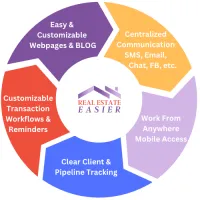
All Your Real Estate Tools And Systems In One Place


© 2026 Real Estate Easier LLC - All Rights Reserved.