

How to Train AI for Your Real Estate Business
AI Is Only as Good as What You Feed It
Most agents try AI once, get a generic response, and conclude it does not work for real estate. The tool is not the problem. The inputs are. AI systems learn from context, and if you give them none, you get output that could have been written for a mortgage broker in any city in the country. That is not useful to you or your clients.
Training AI for your specific business is not a technical skill. It is a communication skill. You are teaching the system who you are, how you work, and what your market actually looks like. Once that foundation is in place, the output shifts from generic to genuinely on-brand and locally relevant.
This post walks through the mechanism, the workflow, and the payoff so you can put this into practice starting today.
What "Training" Actually Means in This Context
You are not programming software or adjusting neural networks. When agents talk about training AI, they mean one of two things:
- Session-level context: Instructions and examples you provide at the start of a conversation that shape every response in that session.
- Persistent memory or custom instructions: Settings inside the AI tool that carry your preferences forward across every session automatically.
Both approaches work. The goal is the same: reduce the gap between what the AI produces on a first draft and what you would actually send, post, or say. The tighter that gap, the higher your leverage. A well-trained AI session can produce a first draft that needs ten minutes of editing instead of forty.
Step One: Write a Brand and Voice Profile
Before you ask the AI to write anything, you need a document that describes you. Not your bio. Not your mission statement. A working profile that tells the AI how you communicate and what you stand for operationally.
Your brand and voice profile should include:
- Your communication style (direct, educational, conversational, data-driven)
- Words and phrases you use regularly and ones you never use
- Your core methodology or philosophy (for example: systems-first, client-for-life, Ninja Selling principles)
- Your primary audience (move-up buyers, investor clients, listing-focused sellers)
- Your market area at a specific level (not just a state, a county or metro)
Paste this profile into the custom instructions section of your AI tool or at the top of every new conversation. This single step eliminates the majority of generic, off-brand output.
Step Two: Add Local Market Data as Reference Material
Generic AI has no idea what a competitive offer looks like in your market, what neighborhoods your clients actually ask about, or what the absorption rate is in the price band you work. You have to tell it.
Build a short market reference document that includes:
- Your core geographic areas by name: specific cities, towns, zip codes, or neighborhoods
- Current or recent market conditions you reference regularly in client conversations
- Local terminology your clients use (for example: condo vs. condominium, townhouse vs. attached, etc.)
- Local context that shapes buyer and seller decisions in your area
When you paste this into a session, the AI can reference actual place names, reflect real market dynamics, and produce content that reads like it was written by someone who works in your market. Because now, in effect, it is.
Step Three: Use Role-Based Prompting
One of the highest-leverage prompting techniques is telling the AI what role to play before you give it a task. This is not about pretending. It is about narrowing the response space so the output is more precise.
Instead of: "Write me an email to a seller lead."
Try: "You are a systems-focused real estate broker who works with experienced sellers. You communicate in a direct, peer-to-peer tone. Write a follow-up email to a seller who attended an open house on one of my listings and asked about listing their own home in the next six months."
The second prompt gives the AI a role, an audience, a tone, and a specific scenario. The output will be dramatically more usable. Role-based prompting is the single fastest way to close the gap between first draft and final product.
Step Four: Build a Prompt Library
A prompt library is exactly what it sounds like: a saved collection of prompts that consistently produce good output for your most common tasks. Think of it as a set of SOPs for your AI use.
Start with your highest-volume tasks:
- Listing description drafts
- Follow-up email sequences for buyer and seller leads
- Weekly market update copy for your database
- Social media captions for new listings and sold properties
- Scripts for common objections you hear in your market
Each prompt in your library should include the role instruction, your voice profile (or a short version of it), the specific task, and any market context that applies. When you use a saved prompt, you skip the setup work and go straight to editing. That is where the time savings compound across your week.
Step Five: Use Your Own Content as Examples
The fastest way to teach an AI your voice is to show it your actual writing. Take three to five pieces of content you have already produced and liked: emails, social posts, listing descriptions, or market update letters. Paste them into the session and say: "Here are examples of my writing. Match this tone and style for everything I ask you to produce in this session."
This technique, called few-shot prompting, is one of the most reliable ways to get AI output that sounds like you wrote it. The AI is pattern-matching your cadence, sentence length, word choices, and structure. The more examples you provide, the tighter the match.
Step Six: Create a Feedback Loop
Training AI is not a one-time setup. It is an iterative process. Every time a response misses the mark, that is data. Tell the AI what was wrong and why, then ask it to try again. Keep refining until the output is usable.
Over time, track which prompts consistently produce good results and which ones need adjustment. Update your prompt library accordingly. If you are working with a team, share the library so everyone is getting consistent, on-brand output from the same starting point.
This is where the leverage scales. One agent spending two hours building and refining a prompt library creates a system that saves that agent and everyone on their team time every single week from that point forward.
What This Looks Like in Production
Here is a realistic workflow for a listing appointment follow-up using a trained AI setup:
- You paste your brand and voice profile plus your market reference document into a new session (or they load automatically via custom instructions).
- You open your prompt library and pull the follow-up email prompt for post-listing-appointment scenarios.
- You add the specific details: seller's name, property address, price range discussed, timeline, and any objections that came up.
- The AI produces a draft in under thirty seconds.
- You spend five to ten minutes editing for accuracy and personal touches.
- The email goes out the same day.
Without this system, that email might take thirty minutes to write, or it might not go out at all because the day got busy. Speed of follow-up is a documented competitive advantage in real estate sales, and this system directly improves it.
Common Mistakes That Undercut Your Results
- Starting cold every session: If you are not loading context at the start of every conversation, you are starting from scratch every time. Build the habit of pasting your profile or use the custom instructions feature.
- Prompts that are too vague: "Write a listing description" will produce mediocre output. Specificity is the mechanism. The more detail you provide, the more precise the response.
- Accepting first drafts without editing: AI produces starting points, not finished products. Your expertise, your relationship context, and your local knowledge should always be in the final version.
- Skipping the feedback step: When something is wrong, correct it inside the session. That in-session correction often fixes the issue for every subsequent response in that conversation.
The Payoff: Leverage Without Headcount
The agents and teams building AI training systems right now are creating leverage that compounds. They are not just saving time on individual tasks. They are building institutional knowledge inside a tool that can execute on it consistently, at any hour, without the overhead of additional staff.
For a solo agent, a well-built prompt library and voice profile can function like a part-time assistant for content and communication tasks. For a team or brokerage, it creates consistency across every agent's output without requiring constant oversight.
This is not about replacing what you do. It is about removing the friction between knowing what you need to do and actually getting it done at the speed your business requires.
Ready to Build a Smarter Business?
Real Estate Easier is built for agents, teams, and brokerages who want systems that actually work in production, not in theory. If you are ready to stop experimenting and start implementing, visit realestateeasier.com to see how we build AI workflows into real estate operations. You can also reach us directly at 617-675-5787.
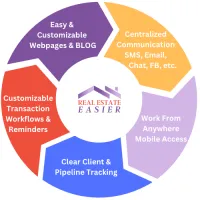
All Your Real Estate Tools And Systems In One Place


© 2026 Real Estate Easier LLC - All Rights Reserved.