

Why Your CRM Isn't Working (And How to Fix It)
The CRM Is Not the Problem
Every agent has a CRM story. You bought the software, paid the monthly fee, imported your contacts, and then... nothing changed. Leads still slipped through. Follow-up still felt chaotic. Production stayed flat.
So you blamed the CRM, switched platforms, and repeated the cycle.
Here is the hard truth: the software is almost never the problem. The problem is that most agents treat a CRM like a filing cabinet instead of a production engine. A cabinet stores things. An engine moves things forward. Those are completely different jobs, and confusing them is what kills conversion.
What a CRM Is Actually Supposed to Do
Strip away the marketing language and a CRM has one job: make sure every contact gets the right action at the right time, without you having to remember it. That is it. It is a promise-keeping machine on your behalf.
When it works, your pipeline has no dead zones. Every lead is either being actively worked, properly nurtured, or archived with a clear reason. When it does not work, you have hundreds of contacts sitting in a digital graveyard with no next step attached to them.
The gap between those two realities is almost always a workflow problem, not a technology problem.
The Four Reasons Your CRM Is Failing You
1. No Defined Lead Stages
If your CRM does not have clearly defined stages with written criteria for what moves a contact from one stage to the next, you do not have a pipeline. You have a list. Stages like "Hot," "Warm," and "Cold" are not criteria. They are feelings. Feelings do not trigger actions consistently.
Build stages around behavior and timeline. A contact who has visited three listings in the last 30 days belongs in a different bucket than someone who signed up 18 months ago and has not opened an email since. The stage determines the action. No stage definition, no consistent action.
2. No Committed Next Step on Every Record
Open your CRM right now and look at your last 20 contacts. How many have a scheduled next step with a date and a specific action attached? If the answer is fewer than 18 out of 20, your CRM is a graveyard.
The Ninja Selling system is built on one foundational principle: every contact in your database gets a next step. Not a vague intention. A specific task with a date. "Call Thursday at 10:00 AM to check in on their timeline" is a next step. "Follow up sometime" is not. Your CRM cannot work if you are not working it at that level of specificity.
3. Too Many Sources, No Source Tracking
Agents plug in Zillow leads, website leads, open house registrations, referrals, and sphere contacts all into the same bucket with no source tag. Then they wonder why their CRM "does not tell them anything useful."
Source tracking is not optional. It tells you which lead channels are converting, which are wasting your money, and how to allocate your follow-up energy. If you are paying for leads from multiple sources and you cannot tell which source produced your last five closings, you are flying blind with someone else's money.
4. Automation Is Replacing Conversation
This is the most common conversion killer in modern real estate. Agents set up drip campaigns, sit back, and call it a follow-up system. It is not. It is a broadcast system. There is a difference.
The Mike Ferry model is unambiguous on this: nothing replaces a live phone call. Automation should be the bridge between conversations, not the substitute for them. If your CRM is sending emails but your call volume has dropped, your automation is working against you. Use it to support outreach, never to replace it.
The Fix: A Five-Step CRM Reset
Step 1: Define Your Stages in Writing
Sit down and write out every stage in your pipeline. For each stage, document two things: what behavior or criteria puts a contact there, and what the standard follow-up action is for that stage. Tape it to your monitor if you need to. Make it a reference document your team can use without asking you.
Step 2: Audit and Tag Every Contact
This is the unglamorous work that determines everything else. Go through your database and assign a stage and a source to every contact. Archive contacts who have no realistic path to a transaction. A smaller, well-organized database outperforms a bloated one every time.
Step 3: Assign a Next Step to Every Active Record
No active contact should leave your audit without a scheduled task. Use your new stage definitions to determine what that task should be. A contact in the "12-Month Buyer" stage gets a monthly check-in call. A contact in the "Active Search" stage gets a weekly touchpoint. Map the action to the stage, then schedule it.
Step 4: Build Automation That Opens Conversations
Review every automated sequence you have running. Ask one question about each one: does this make it easier for the contact to start a conversation with me, or does it let me avoid having that conversation? Delete anything in the second category. Keep and refine anything in the first. Your automation should be creating phone call opportunities, not replacing them.
Step 5: Review Your CRM Daily, Not Weekly
A CRM review is not a weekly event. It is a daily discipline that takes 15 minutes if your system is organized. Every morning, you should know exactly who needs to hear from you that day and what you are going to say. If that review takes longer than 20 minutes, your stages or your task structure needs work.
What Conversion Actually Looks Like When This Works
When your CRM is running as a production engine, a few things become observable. Your follow-up speed increases because you always know who is next. Your conversion rate from lead to appointment improves because no lead ages out uncontacted. Your client relationships deepen because you are reaching out proactively instead of reactively.
You also stop feeling like the business is running you. That shift is not philosophical. It is the direct result of having a system that removes ambiguity from your day. You know what to do because the system tells you what to do. That is the payoff.
The Agent Who Fixes This First Wins
Most agents in your market are working with the same pool of leads you are working with. The ones converting at a higher rate are not necessarily getting better leads. They are working their database with more precision and more consistency.
A CRM that functions as a production engine is not a competitive advantage you eventually get around to. It is the foundation that makes every other marketing dollar and every other prospecting hour worth something.
If you are ready to stop switching platforms and start fixing the actual problem, visit realestateeasier.com or call 617-675-5787. Real Estate Easier works directly with agents, teams, and brokerages to build the kind of systems that turn a database into a production machine.
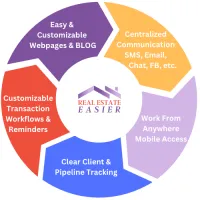
All Your Real Estate Tools And Systems In One Place


© 2026 Real Estate Easier LLC - All Rights Reserved.