
Why Spreadsheets Are Killing Your Pipeline
Every producing agent I talk to has a moment where they admit it: "I've got most of it in a spreadsheet." Sometimes it's Google Sheets, sometimes Excel, sometimes a shared doc with an assistant. The agent says it apologetically, like they already know it's the wrong answer.
They're right. It is the wrong answer. And it's costing them more than they realize.
Spreadsheets don't follow up
This is the core issue. A spreadsheet is a list. A CRM is a system. A list sits there waiting for a human to act. A system acts whether the human shows up or not.
When a new lead comes in, a spreadsheet does nothing. It does not text the lead back in 4 minutes. It does not assign a task. It does not fire a five-email nurture sequence. It waits. And while it waits, the lead Googles "real estate agent near me" and fills out someone else's form.
Every day your database lives in a spreadsheet, you are paying the penalty of manual follow-up. That penalty is measured in closings you never knew you lost.
Spreadsheets don't remember
Can you tell me, from your spreadsheet, the last time you spoke to every person in it? When their birthday is? What their home anniversary is? Whether they replied to your last market update? Whether they visited your IDX site twice last week?
You can't. Because a spreadsheet captures data at a moment — not context over time. A real system tracks every touchpoint automatically and surfaces exactly the right person to call today.
Spreadsheets don't segment
Your past clients need a different cadence than your cold leads. Your sphere needs a different message than your internet leads. Your expireds need a completely different sequence than your open house sign-ins.
A spreadsheet can have a "category" column. A system can actually run a different 12-month sequence for each one — automatically.
Spreadsheets don't scale
At 100 contacts, the spreadsheet is fine-ish. At 500, it's a pain. At 1,000, it's a liability. At 2,000, it becomes the reason you stopped following up at all — because the emotional weight of "what am I even looking at?" takes over and you avoid it entirely.
Producing agents hit this wall and then make the worst decision possible: they keep adding to the spreadsheet anyway. Because migrating to a real system "feels like a project." So the business grows, the database grows, and the gap between what's possible and what's happening grows with it.
The hidden cost nobody calculates
Here's a rough exercise. Count the contacts in your database. Multiply by 0.10 (a conservative estimate of the percentage who will transact in the next 24 months). Multiply by your average commission. That's your total database opportunity value.
Now ask: what percentage of those people will hear from you at all in the next 90 days? Most agents, honestly, it's under 20%. Which means 80% of your database opportunity is quietly walking to another agent.
A spreadsheet cannot change that math. Only a system can.
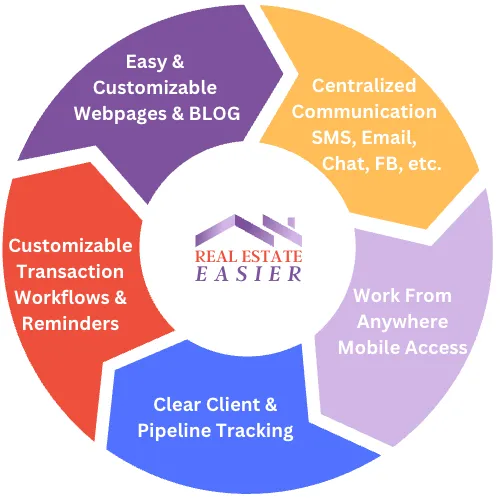
What a real system does differently
- Captures every lead automatically, from every source
- Fires speed-to-lead workflows the second the lead hits
- Segments by type, stage, source, and behavior — automatically
- Runs 12-month nurture campaigns in the background
- Surfaces today's call list ranked by priority
- Tracks every touch, every reply, every website visit
- Shows you pipeline value and forecast revenue at a glance
- Accumulates data so you get smarter every month
A spreadsheet does none of that. It's a list. Lists don't build businesses.
The harder truth
Most agents know the spreadsheet is not the answer. They know they should be in a real system. What stops them isn't ignorance — it's the fear that the "real system" is going to be another login they don't understand, that they'll spend weeks trying to set up, and that they'll abandon in three months like the last one.
That fear is legitimate. The solution is not to buy another CRM and hope. The solution is to get a done-for-you setup where the system is built before you log in — so you never have to become the CRM admin.
Stop patching the spreadsheet. Stop adding columns. Stop telling yourself "next quarter." Every week you stay in it, you're paying the bill for deals you never see.
Your database is the highest-value asset you own. Treat it like one.
All Your Real Estate Tools And Systems In One Place


© 2026 Real Estate Easier LLC - All Rights Reserved.