

How Team Leaders Can Standardize Agent Performance With Built-In Coaching
The Performance Gap That Kills Team Profitability
Every team leader knows the feeling: one agent closes eight deals in a quarter while another closes two. Same market, same leads, same commission split. The gap is not talent. It is process. When coaching lives in your head instead of your systems, performance becomes a personality contest rather than a repeatable outcome.
Standardizing agent performance is not about cloning your top producer. It is about building a floor beneath every agent on your roster so that your lowest performer produces at a level that actually sustains the business. Built-in coaching is how you get there without adding 20 hours to your week.
Why Ad Hoc Coaching Does Not Scale
Most team leaders coach reactively. An agent loses a listing presentation, so the leader debrief. An agent ghosts their database for 60 days, so the leader intervenes. This model has two fatal flaws:
- It depends entirely on the leader noticing the problem before damage is done.
- It delivers inconsistent input because the coaching varies based on the leader's availability, mood, and memory.
Mike Ferry built an entire methodology around scripting and repetition precisely because inconsistency is the enemy of production. Ninja Selling reinforces the same truth from a relationship angle: the agents who win are the ones who execute the same high-value behaviors every single day without needing external motivation to do it. Your coaching architecture needs to reflect that philosophy.
What Built-In Coaching Actually Means
Built-in coaching means the system delivers the right prompt, the right accountability check, and the right skill reinforcement at the right point in the workflow, without requiring the team leader to be in the room.
Think of it as the difference between a GPS and a paper map. Both can get an agent to the destination. But the GPS recalculates in real time, flags wrong turns immediately, and keeps the driver on track without requiring a co-pilot. Built-in coaching is your team's GPS.
Operationally, this looks like three integrated layers:
Layer One: Activity Standards That Are Visible, Not Just Verbal
If your activity expectations exist only in an onboarding document or a weekly meeting, agents will drift. Standards need to live inside the tools agents use every single day. That means your CRM or platform surfaces the right daily numbers, and agents can see their own scorecards without waiting for a one-on-one.
Specific minimums to standardize across your team:
- Database contacts per day (Ninja Selling recommends a minimum of 20 live contacts weekly for a working database strategy to produce consistent referrals)
- Follow-up attempt cadence for active leads by lead source
- Listing appointment preparation checklist completion before the meeting
- Post-closing touchpoint sequence timing
When these standards are embedded in the workflow rather than posted on a whiteboard, agents self-correct before the leader has to say a word.
Layer Two: Skill Delivery at the Point of Need
Traditional training dumps all the content upfront during onboarding and then expects agents to recall it six months later when they actually need it. That is not how skill acquisition works.
Built-in coaching delivers micro-skill content at the exact workflow step where the agent needs it. An agent preparing for a buyer consultation gets the consultation framework and key questions before the appointment, not during a monthly training call they may have half-attended. An agent logging a price reduction conversation gets the objection-handling language right then.
This is called spaced, contextual learning, and the research behind it is not new. The University of Waterloo's work on the forgetting curve, building on Hermann Ebbinghaus's foundational research, shows that people forget approximately 50 percent of new information within an hour and up to 90 percent within a week without reinforcement. Embedding skill delivery into the workflow is the structural answer to that problem.
Layer Three: Leader Dashboards That Prioritize Coaching Time
Even with strong systems, a team leader still needs to coach. The question is who gets coached first, on what, and for how long. Without data, leaders default to coaching whoever shows up to their office or whoever is loudest about needing help. That is not a strategy.
A leader dashboard that surfaces lagging activity, stalled pipelines, and skill gaps by agent allows you to allocate your coaching hours where they will produce the highest return. You spend 30 minutes with the agent who is two deals below pace because you can see it, rather than spending 90 minutes with the agent who just wants to talk because they are comfortable with you.
Building the System: A Practical Workflow
Here is how to move from reactive coaching to a standardized system without a six-month overhaul:
- Step One: Define the non-negotiable daily behaviors for every agent role on your team. Not aspirational targets. Minimums. What does a full-time buyer's agent do every day to stay in production?
- Step Two: Map those behaviors to your existing platform. Where in the workflow does each behavior happen? What trigger or prompt can the system send to reinforce it?
- Step Three: Attach skill content to workflow steps. Identify the five or six skill gaps that most commonly cause stalled deals or lost appointments on your team. Build short, specific training assets and connect them to the workflow stage where agents need them.
- Step Four: Build a weekly leader review cadence using your dashboard data, not anecdote. Schedule 30 minutes every Monday to review the previous week's activity metrics by agent before your team call. This changes the conversation from reactive to proactive.
- Step Five: Establish a clear escalation threshold. When an agent's numbers drop below a defined floor for two consecutive weeks, that triggers a structured coaching conversation, not an informal chat. Define what that conversation looks like before you need to have it.
The Compounding Effect on Team Production
When coaching is built into the system, three things happen at the same time:
- Your middle performers get consistent reinforcement they were not getting before, which moves them toward your top tier.
- Your new agents ramp faster because the system delivers the right guidance at the right time rather than leaving them to figure it out between team meetings.
- Your top producers operate with less interference from reactive team drama because the leader is spending time on strategic coaching, not crisis management.
The practical result is that your team's production floor rises without requiring proportionally more of your time. That is the leverage that built-in coaching creates.
What This Looks Like on a Real Team
Consider a team of eight agents where two agents consistently hit targets and six cycle between decent months and slow ones. The typical response is to either hire more agents to average up or to burn leader hours coaching the inconsistent six individually. Neither approach addresses the root problem: the system is not holding performance standards on behalf of the leader.
When activity minimums are visible inside the platform, when skill content surfaces at the right workflow stage, and when the leader's review cadence is data-driven, the six inconsistent agents get a consistent input stream they were not getting before. Some will respond and step up. Others will self-select out because the system makes accountability unavoidable. Both outcomes improve team profitability.
Ready to Build a Coaching System That Runs With Your Team?
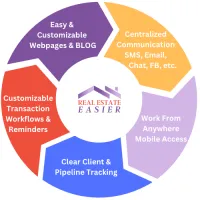
Real Estate Easier is built by a working broker who runs this system in a live production environment. The platform is designed specifically for team leaders who want to standardize performance without adding overhead to their own schedule.
Explore the platform at realestateeasier.com or call directly at 617-675-5787 to talk through how built-in coaching applies to your team's current structure. No pitch deck required: just a direct conversation about what your team actually needs.
All Your Real Estate Tools And Systems In One Place


© 2026 Real Estate Easier LLC - All Rights Reserved.